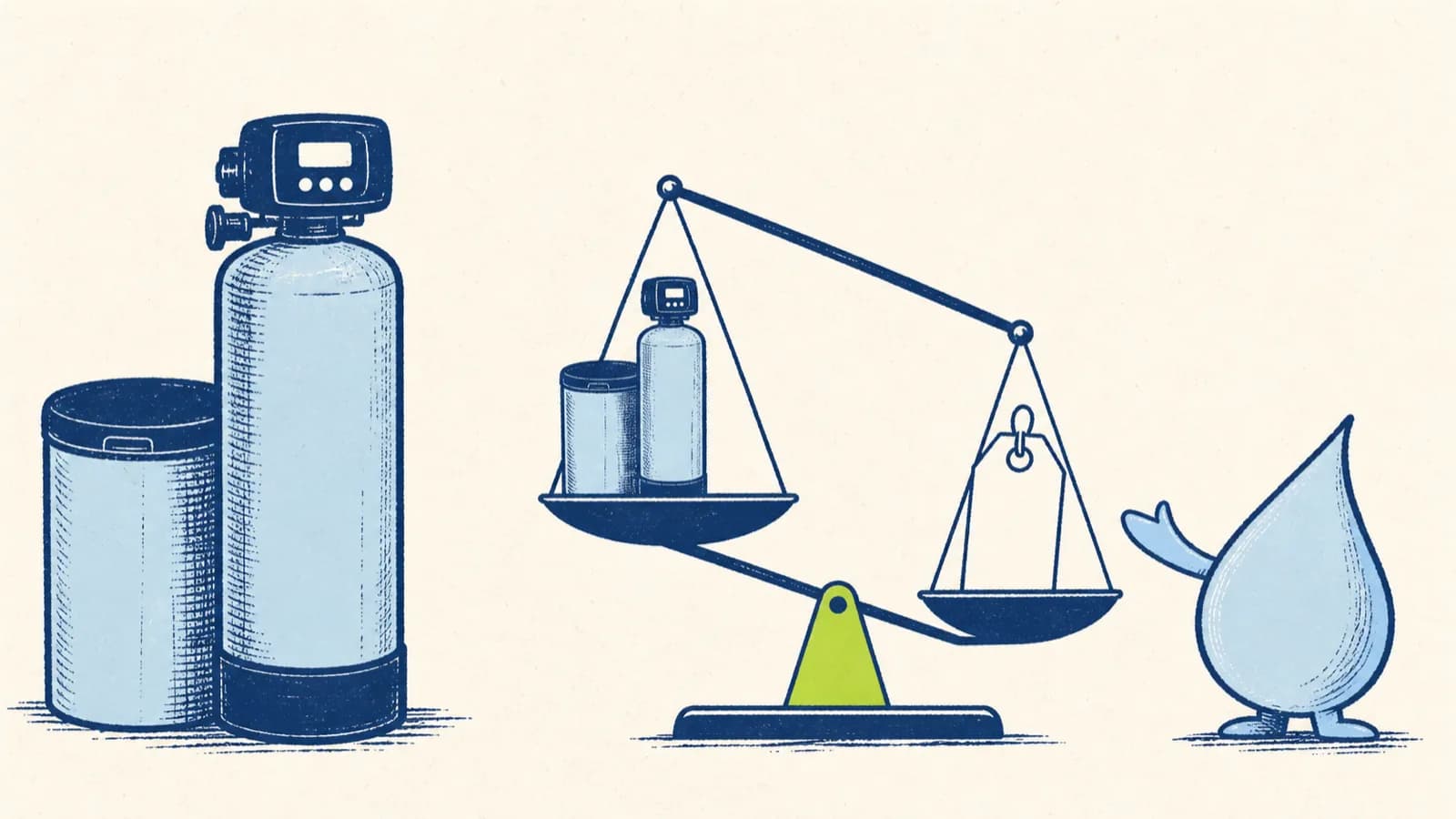
By the time a homeowner asks what a softener costs, they've already seen the answer: online, a water softener runs anywhere from $200 to $6,000, averaging about $3,100 installed (This Old House, 2026). So repeating a number isn't the conversation — it's the least useful thing you can do. The conversation a dealer wins is why the right-sized system for this home lands where it does, and what that price includes that a mail-order box doesn't. Sell the fit, and the number stops being an objection.
Why is there a $200-to-$6,000 spread in the first place?
Because "water softener" describes a range of systems, not one product. Market-reported figures put a basic single-tank salt unit around $500–$1,700, a dual-tank system near $1,000–$5,000, and a salt-free conditioner around $800–$4,000, with installation labor adding roughly $150–$1,000 (This Old House, 2026). Those aren't competing prices for the same thing — they're different capacities, valve qualities, and install scopes. When a customer sees the low end and your quote near the middle, the honest explanation is that you're pricing the system their water actually needs, not the smallest box that will fit under the sink.
How do you size a softener — and price it?
The number isn't arbitrary; it comes out of the water. Sizing a softener is a short calculation any dealer can walk a customer through, and doing it out loud is the most disarming price conversation there is — because the customer watches the price get built from their own numbers.
- 1
Start with the household's water use
Figure roughly 75–100 gallons per person per day — the standard sizing assumption dealers use (USGS puts typical indoor use near 80–100). A family of four is about 300–400 gallons a day. - 2
Multiply by the hardness
Take the water's hardness in grains per gallon (1 gpg = 17.1 mg/L). Gallons per day × gpg = grains of hardness to remove each day. Four people on 10-gpg water is about 3,000 grains a day. - 3
Add for iron
Iron loads the resin too — add about 5 gpg of hardness for every 1 mg/L of iron before you size. A well with 2 mg/L of iron adds meaningfully to the unit. - 4
Size for about a week between regenerations
Multiply daily grains by seven and pick the nearest standard capacity. That 3,000-a-day home lands near a 24,000–32,000-grain unit — and that capacity, not a sales target, is what sets the price.
Show that math and "why is it that much?" usually answers itself. A bigger household on harder water with iron genuinely needs a larger, higher-capacity unit than a couple on moderately hard city water — the price difference is the water, made visible. It's the same read that turns qualifying a softener lead into a scoped quote.
How do you answer "the box store sells one for $500"?
Agree with the fact, then reframe the comparison. A $500 unit is real — it's a DIY, unsized, uninstalled softener, and for a handy customer on simple water it might even be fine. What the price doesn't include is everything that makes a softener work in their home: a diagnosis of the actual water, the correct grain capacity, a correct install, and a local specialist to call when it needs service. You're not more expensive for the same thing; you're pricing a different, complete thing. Customers respect that distinction when you make it plainly instead of defending the number — and that trust is what turns a curious searcher into a booked job, the whole aim of getting more water-treatment leads.
Is a salt-free "softener" the cheaper option?
Only if the customer doesn't need softening. Salt-free "conditioners" use template-assisted crystallization to reduce scale, and they have real uses — but they do not remove hardness, and only salt-based ion-exchange systems are certified as softeners under NSF/ANSI 44. When a price-shopping customer waves a cheaper salt-free unit, they're often comparing two different products without knowing it. The trustworthy move is to say so: if they truly want soft water — no scale, better lather, longer appliance life — a conditioner isn't a discount softener, it's a different tool.
What about the customer who found a cheaper price online?
Let them keep the number and take back the diagnosis. A homeowner researching cost online is doing exactly what they should; a neutral cost guide like This Old House gives them the honest market range. What the internet can't give them is their number — the capacity their water and household actually require, and a person who stands behind the install. Point them to the research, then offer the one thing the research can't: a real diagnosis of their water — the read an AI water specialist makes from a ZIP — and a system sized to it.