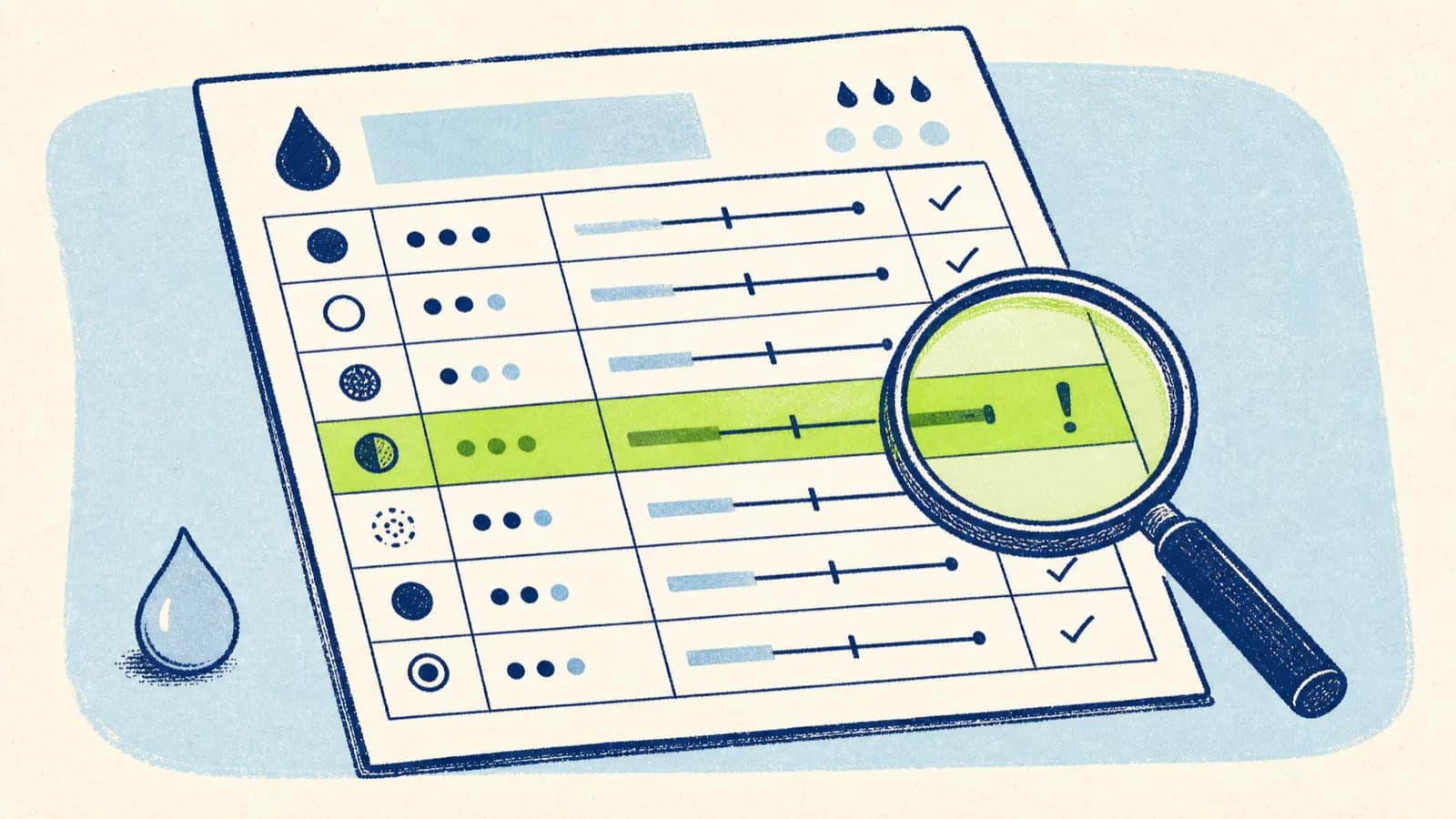
A water test report is a scope sheet in disguise. Nitrate at or above 10 mg/L and arsenic above 10 ppb (0.010 mg/L) are long-standing federally enforceable ceilings; PFOA and PFOS above 4.0 parts per trillion joined them under the EPA's 2024 PFAS rule — all readings that point to reverse osmosis or dedicated media (EPA). Hardness above about 7 grains per gallon and iron above 0.3 mg/L are the aesthetic readings that scope most softeners and iron filters (USGS; EPA). Read a report in that order — enforceable health limits first, then the aesthetics that drive daily complaints — and it tells you which system belongs on the truck. It's the same read an AI water specialist makes from a ZIP before anyone books the in-home test.
What's the difference between mg/L, ppm, and grains per gallon?
They are three ways of writing the same measurement, and mixing them up is the fastest way to misread a report. For dilute drinking water, 1 mg/L equals about 1 part per million (ppm) — the two are used interchangeably on most reports. Hardness and sometimes iron are the exceptions, because softener sizing is done in grains per gallon (gpg), where 1 gpg = 17.1 mg/L (USGS).
So a report that lists hardness as 171 mg/L is describing 10 gpg; one that lists 12 gpg is describing about 205 mg/L. When a homeowner reads "10" off a strip and you quote a system for "10," confirm you mean the same unit — a 17× error in either direction sizes the wrong tank.
EPA limit for nitrate — the enforceable ceiling that points to RO or anion exchange.
Source: EPA
EPA 2024 limit for PFOA and PFOS, each — the newest enforceable line (revision proposed).
Source: EPA, 2024
EPA secondary limit for iron — above it you get staining, not a health violation.
Source: EPA
Which readings are enforceable health limits, and which are just aesthetic?
The EPA splits drinking-water standards into two groups, and a dealer who reads them in the wrong order scopes the wrong system. Primary standards are legally enforceable, health-based Maximum Contaminant Levels: nitrate, arsenic, lead, and — since 2024 — several PFAS compounds. Secondary standards cover aesthetics: iron, manganese, hardness, TDS, taste, color, and odor. They aren't federally enforced, but they drive the stains, scale, and smells that actually make a homeowner call you (EPA).
The practical rule: if a health reading is above its primary limit, that's the lead reason for the system, and the fix has to be a treatment certified to reduce it. The aesthetic readings then shape the rest of the build — the softener size, whether you need an iron stage, how the household will judge the result day to day.
What hardness number means the customer needs a softener?
Hardness is the reading that sells the most equipment, so it's worth knowing where the lines are. The USGS classifies water as soft below 60 mg/L, moderately hard from 61–120 mg/L, hard from 121–180 mg/L, and very hard above 180 mg/L (USGS). In grains, the industry convention lands hard water at roughly 7–10.5 gpg and very hard above 10.5 gpg.
If a report shows 8 gpg with no iron, that's a straightforward softener sized to the household's flow. If it shows 20 gpg plus 1 mg/L of iron, the sizing math changes — a common approach adds roughly 5 gpg of "compensated hardness" per 1 mg/L of iron before you pick the grain capacity. Softening also isn't the only option worth naming: a salt-free conditioner reduces scale but does not remove hardness (it's template-assisted crystallization, not ion exchange), which matters when a customer asks why one quote is cheaper.
What do the 2024 PFAS limits cover, and are they changing?
PFAS is the reading most likely to be new to a report, and the one to state carefully. The EPA's April 2024 rule set enforceable limits of 4.0 ppt for PFOA and 4.0 ppt for PFOS, with 10 ppt each for PFHxS, PFNA, and GenX (HFPO-DA) and a Hazard Index of 1 for mixtures (EPA, 2024). Utilities have until 2029 to comply under the rule as finalized.
Here's the honest part: in 2025–26 the EPA proposed to extend the PFOA/PFOS deadline and to rescind the limits on the other compounds. Evidence on the long-term picture is still developing, and the numbers may move. Treat the 2024 values as current-as-of mid-2026, date-stamp them for the customer, and where a test shows PFAS above these levels, the defensible fix is reverse osmosis or activated carbon certified to reduce it (NSF/ANSI 53, 58, or P473).
How do you map each reading to the right treatment?
This is the table worth keeping next to the test. Each row is a reading, its EPA classification, whether it's enforceable, what it signals about the home, and the treatment class — with the NSF/ANSI standard the equipment should carry.
| Reading | EPA limit / class | Enforceable? | What it signals | Typical treatment (NSF/ANSI) |
|---|---|---|---|---|
| Hardness | soft under 60 · hard 121–180 · very hard over 180 mg/L (USGS) | No (aesthetic) | scale, soap use, appliance wear | Softener (44) |
| Nitrate (as N) | 10 mg/L | Yes (primary) | agricultural / septic influence | RO (58) or anion exchange |
| Arsenic | 0.010 mg/L (10 ppb) | Yes (primary) | geologic; chronic health | RO (58) or adsorptive media |
| Lead | action level 15 → 10 ppb (2027); MCLG 0 | Yes (treatment technique) | plumbing / service line | POU RO or NSF 53 lead-rated |
| PFOA / PFOS | 4.0 ppt each (2024) | Yes (comply 2029) | industrial / firefighting foam | RO (58), NSF 53 or P473 |
| PFHxS / PFNA / GenX | 10 ppt each; Hazard Index 1 | Yes (2024; revision proposed) | PFAS mixture | RO (58) or activated carbon |
| Iron | 0.3 mg/L | No (secondary) | staining; ferrous vs. ferric | oxidation + filter; softener if low & ferrous |
| Manganese | 0.05 mg/L | No (secondary) | black staining | oxidizing filter / greensand |
| TDS | 500 mg/L | No (secondary) | overall mineralization | RO (58) |
Read top to bottom: enforceable health readings set the lead reason for the system; aesthetic readings shape the softener and iron stages. A reading that's blank isn't the same as one that's below the limit — an unrun test is a reason to run one, not a clean bill.
How should a dealer actually work a report?
The order matters more than the memorization. Working a test the same way every time keeps you from anchoring on the hardness number and missing a health reading underneath it.
- 1
Scan the health limits
Check nitrate, arsenic, lead, and PFAS against their primary limits first. Any exceedance is the lead reason for the system. - 2
Read the aesthetics
Then hardness, iron, manganese, and TDS — the readings that drive daily complaints and size the softener. - 3
Factor the source
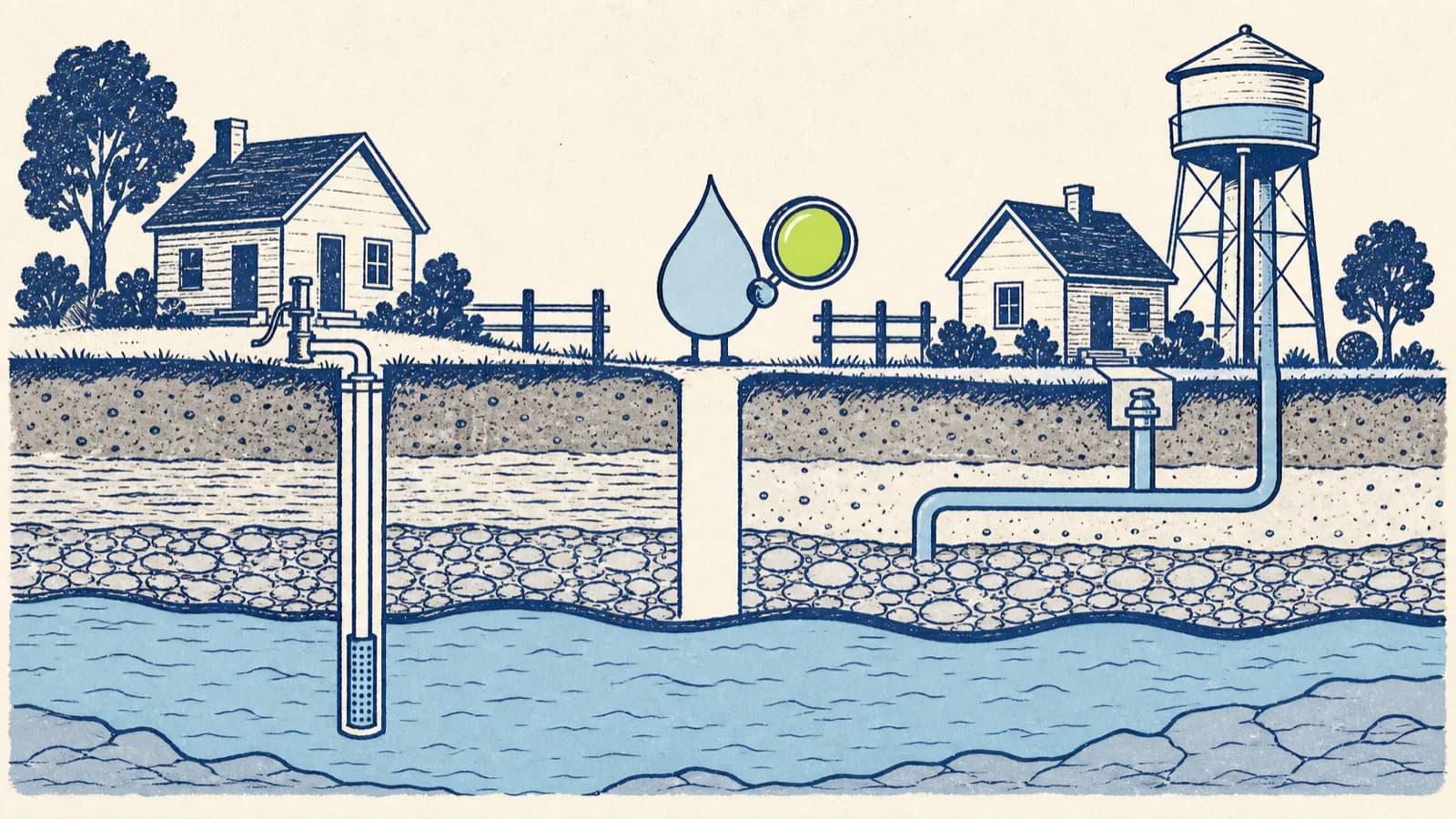
A private well and a city connection carry different risk profiles; the source reframes which readings you expect and re-test. - 4
Match to a certified system
Map each flagged reading to a treatment carrying the right NSF/ANSI standard — the certification, not the brochure, is the proof.
If you're qualifying a lead from a photo of a strip or a utility report, the same order applies — it's exactly how a specialist qualifies the lead before the truck rolls. The report doesn't sell the job on its own; read in order and tied to certifications, it tells you which job is actually there.