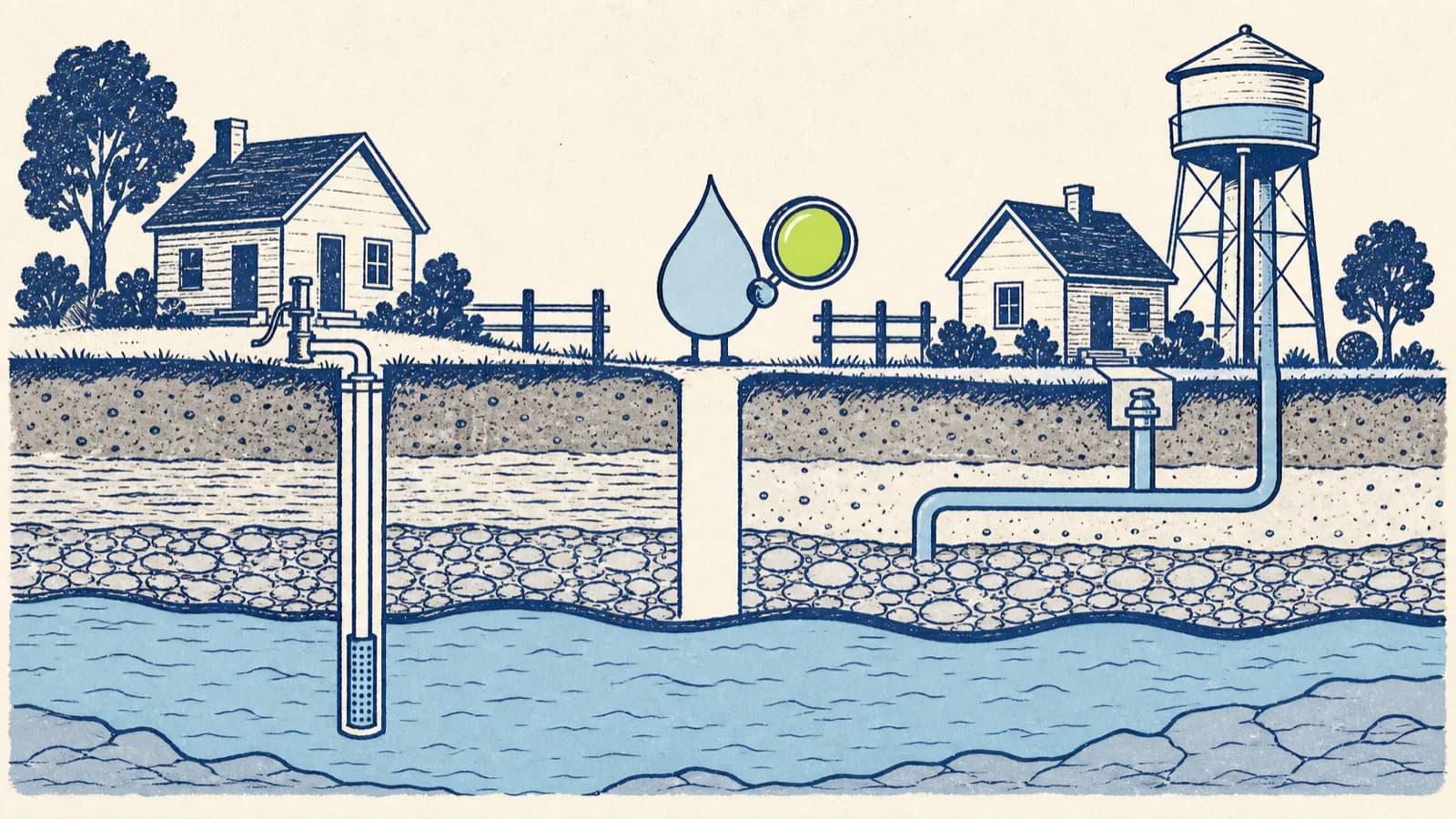
The first question in any water-treatment diagnosis isn't "what's wrong" — it's "where does the water come from." More than 43 million Americans (about 15% of the country) drink from a private well the EPA doesn't regulate, and a USGS study of roughly 2,100 wells found about 1 in 5 exceeded a federal health benchmark (USGS). City water is treated and reported; well water is whatever the local geology and land use put into it, checked by no one but the owner. Same house, same street — a well and a city connection are two different diagnostic problems.
Americans (~15%) on private wells not regulated by the Safe Drinking Water Act.
Source: EPA / USGS
Domestic wells that exceeded a federal health benchmark in a USGS study of ~2,100 wells.
Source: USGS
Wells tested with a microbial detection — the risk a utility would normally screen out.
Source: USGS
What's actually different between well and city water?
Oversight, and what the water carries. City water comes from a public utility regulated under the Safe Drinking Water Act: it's treated to federal limits, tested on a schedule, and reported to the customer every year in a Consumer Confidence Report. If something exceeds a limit at the plant, the utility has to act and notify.
A private well has none of that. About 43 million people — roughly 15% of the US, across more than 23 million households — draw from one, and the EPA does not regulate them (EPA). No mandatory testing, no treatment unless the owner installs it, no annual report. The water is a direct sample of the local aquifer, which means it carries whatever the geology and the land use above it contribute. That's the diagnostic difference: city water is a treated product with known aesthetics gaps; well water is raw groundwater with an unknown profile until someone tests it.
Is well water safe?
It can be perfectly good — but "safe" is the wrong frame, because no one is checking. The honest word is unmonitored. In a USGS study of about 2,100 domestic wells, roughly 1 in 5 exceeded a federal health benchmark for at least one contaminant, and microbial contamination was detected in about a third of wells tested (USGS). That doesn't mean most wells are dangerous; it means the risk is real, varies enormously by location, and is invisible without a test.
This is the single most useful thing a dealer can tell a well owner: the utility isn't testing your water, so the only way to know is to test it — and the local risks (nitrate in farm country, arsenic in certain geologies, bacteria near septic) are specific enough that a real panel beats any guess.
What problems show up in well water?
Wells carry the signature of their ground. The common ones:
- Hardness — calcium and magnesium from rock; the most frequent well complaint, and what scopes a softener.
- Iron and manganese — staining and metallic taste; ferrous ("clear-water") iron turns red only after it sits, while ferric iron is red at the tap. Iron's aesthetic limit is 0.3 mg/L, manganese's is 0.05 mg/L (EPA secondary standards).
- Sulfur (hydrogen sulfide) — the "rotten egg" smell.
- Nitrate — from fertilizer and septic; the enforceable limit is 10 mg/L (EPA), and it's a genuine health concern for infants, not just an aesthetic one.
- Arsenic — naturally occurring in some geologies; MCL 10 ppb (EPA).
- Bacteria — total coliform and E. coli, especially near septic or after flooding.
What problems show up in city water?
Different list, because the utility already handled the microbial and acute risks. What's left at the tap:
- Chlorine or chloramine taste and odor — the disinfectant that keeps the water safe to the tap is also the top taste complaint (NSF/ANSI 42 territory).
- Hardness — not federally regulated because it's aesthetic, so a utility can deliver perfectly "compliant" water that still scales your fixtures.
- Lead — not usually from the utility's water but from the home's own plumbing and service line; the action level is 15 ppb, dropping to 10 ppb under the Lead and Copper Rule Improvements in 2027.
- PFAS — the EPA's 2024 rule set PFOA and PFOS at 4.0 ppt; parts are under proposed revision, so it's a moving target worth date-stamping.
- Disinfection byproducts — trihalomethanes and similar, a tradeoff of chlorination.
How do the two compare at a glance?
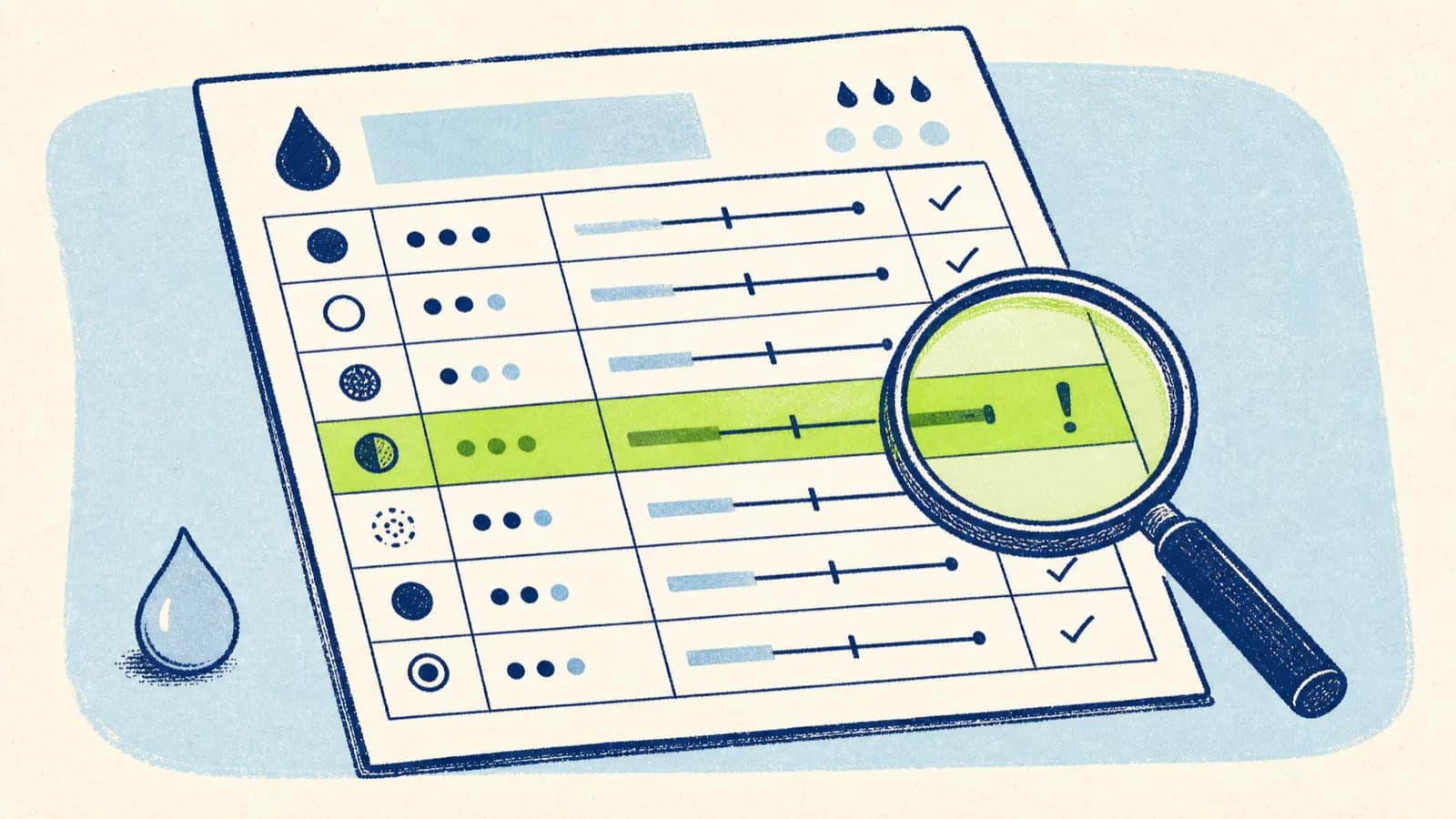
This is the diagnostic map worth keeping next to the phone. Each row is the source where the issue shows up most, the relevant limit or standard, and the treatment it typically scopes.
| Issue | More common in | EPA / health context | Typical treatment (NSF) |
|---|---|---|---|
| Hardness | Both (well often higher) | Aesthetic, not regulated | Softener (44) |
| Iron / manganese | Well | Secondary: 0.3 / 0.05 mg/L | Oxidation / filter (42) |
| Sulfur smell | Well | Aesthetic | Oxidation / carbon |
| Nitrate | Well (ag areas) | MCL 10 mg/L | RO (58) / anion exchange |
| Arsenic | Well (geologic) | MCL 10 ppb | RO (58) / adsorptive (53) |
| Bacteria | Well | MCLG 0 | UV (55) / chlorination |
| Chlorine taste | City | Aesthetic | Carbon (42) |
| Lead | City (home plumbing) | Action level 15 → 10 ppb (2027) | RO (58) / certified (53) |
| PFAS | Both | PFOA/PFOS 4.0 ppt (2024) | RO (58) / carbon (P473) |
How should a dealer qualify a well vs. city lead?
Ask the source first — it sets the whole scope. For a well, assume nothing and test broadly: a sensible first panel is bacteria, nitrate, arsenic, hardness, iron, manganese, and pH, plus whatever the local geology is known for. The breadth is the point; a softener that ignores a nitrate or bacteria problem is the wrong system.
For city water, start from the utility's Consumer Confidence Report — it tells you what's already handled — then test at the tap for the things the report can't cover: hardness, lead from the home's plumbing, and the specific aesthetic complaint that brought the customer in. This is the same source-first read an AI water specialist makes from a ZIP, and it's the front half of how a specialist qualifies a lead before anyone books the in-home test. Pair it with the water-test reading guide once the results come back.